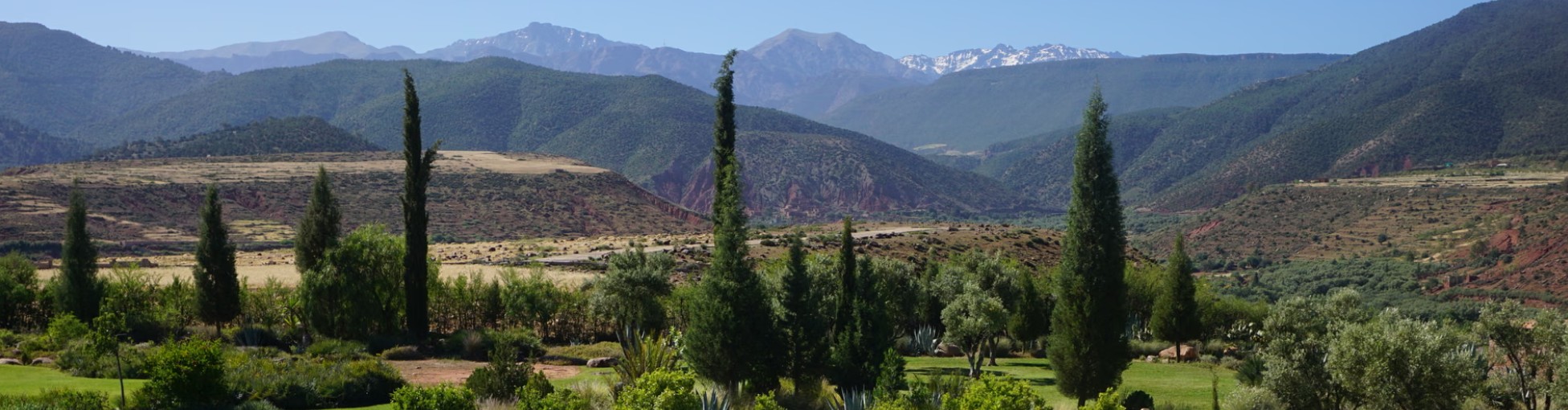
Atlas Mountains panorama

Morocco · Atlas Mountains · Single Varietal

AYN AL ATLAS

عين الأطلس

The AAA Standard — Ancestral · Atlas · Authentic

100% Picholine Marocaine · Cold-pressed · Batch #001

AYN AL ATLAS
The Original Warrior Olive

Not a blend. Not a generic Mediterranean mix. A single-varietal oil from Morocco's indigenous survivalist olive — lab-certified, blockchain-verified, batch-numbered. The only olive oil you can fully verify before you buy.

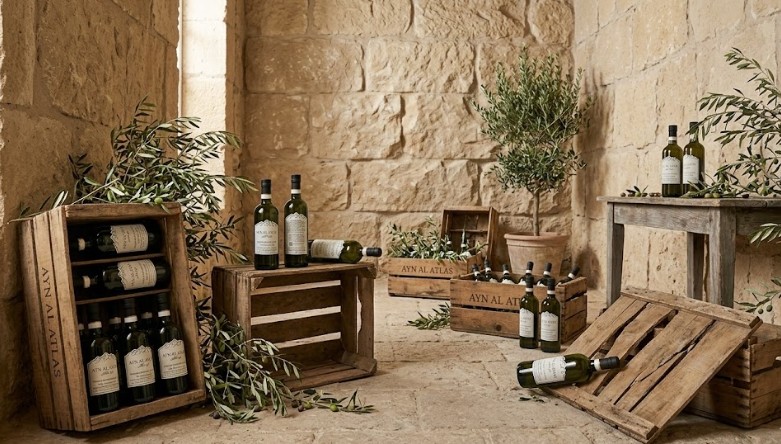
Heritage olive oil crates against stone wall
Picholine Marocaine 100% single varietal · Atlas Mountains
Ancestral · Atlas · Authentic
Single Varietal · Blockchain Verified · Batch Numbered
Atlas Mountains

The Standard

Three letters. One promise.

A

Ancestral

2,000 years of heritage

The Picholine Marocaine — known to Moroccan farmers as "Beldi" (Traditional) — has been cultivated in the Atlas foothills for millennia. No other variety carries its mineral depth or phenolic density. We press the same fruit, the same way, under the same Atlas sky.

A

Atlas

Mountain-stressed fruit

At 115°F+ in mineral-poor, rocky soil with prolonged drought, these trees fight to survive. That biological stress forces the production of polyphenols as an internal defense mechanism. The adversity of the grove becomes the potency of your oil.

A

Authentic

Blockchain verified

Every bottle carries a QR code linked to its specific lab report — polyphenol count, acidity, harvest date, grove coordinates, press temperature. You verify before you pour. Not a claim. A published record.

Picholine Marocaine
The Original Warrior Olive — Genetic Identity, Not Just a Label

In the world of olive oil, "Picholine Marocaine" is not a marketing term. It is a distinct genetic identity — an indigenous Moroccan landrace that represents over 90% of all olive trees in Morocco, uniquely adapted over thousands of years to the North African desert climate.

1

Etymology · The name's origin

Not the French Picholine

The name "Picholine" traces to the Picholini brothers in 18th-century France — a family who developed a specific olive-curing process using lye and brine. While the French variety became a cocktail olive, the Marocaine is entirely distinct: an indigenous landrace shaped by thousands of years of North African evolution, not European cultivation.

"Ours is not a generic blend. It is 100% Picholine Marocaine — the indigenous survivalist of the Atlas."

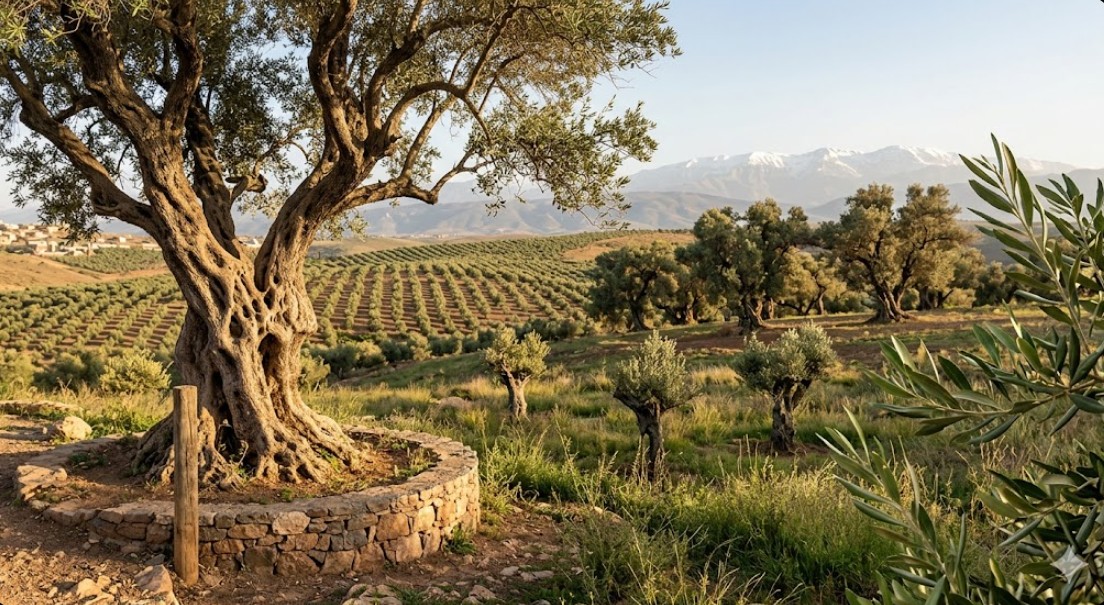
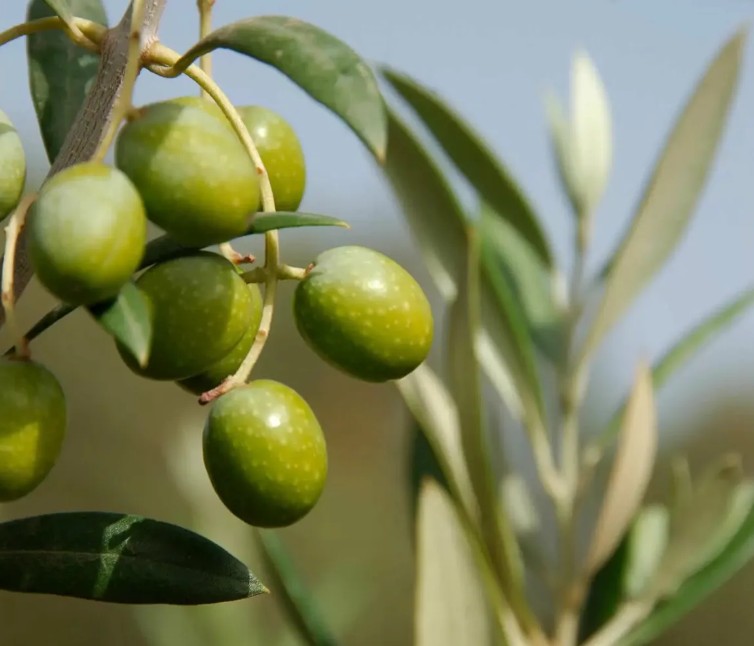
A living Picholine Marocaine — estimated age over 1,000 years

A living Picholine Marocaine · Estimated age: over 1,000 years

2

Survivalist DNA · 90% of Morocco's trees

Built to survive the desert

The Picholine Marocaine is a "Rustic" tree — adapted to survive prolonged drought, temperatures above 115°F, and rocky, mineral-poor soil. Under this extreme stress, the tree floods its fruit with polyphenols as its own internal defense mechanism. When you consume the oil, you are consuming that concentrated defense data.

"A single-varietal oil that carries the molecular strength of the desert."

3

Sensory marker · The sting tells the story

High pungency is the proof

The Picholine Marocaine is famous for its peppery kick at the back of the throat — the hallmark of the variety and a direct indicator of high Oleocanthal content. This is not a flaw. It is confirmation. The sting tells you the polyphenols are present, intact, and working. If your oil goes down smooth and silent, look elsewhere.

"The peppery sensation is not a flaw. It is the proof."

4

Stability · Natural antioxidant preservation

The oil that preserves itself

The Picholine Marocaine produces an oil of exceptional oxidative stability. Its natural antioxidant levels are so high they function as a built-in preservative — the oil resists going rancid far longer than European varieties. Combined with our nitrogen-sealing process, what reaches you is what left the press.

"The antioxidants that protect the tree now protect the oil — and eventually, you."

Known locally as
Beldi Traditional / Local
Zitoun The Olive
Bouchouika Regional Heritage Name
Picholine Marocaine International Classification

"This distinguishes us from Mediterranean Blends that use weaker, mass-market olives. AYN AL ATLAS is a single-varietal oil that carries the genetic authority, molecular strength, and sensory signature of Morocco's original warrior olive."

The variety in numbers

Why Morocco.
Why this olive.

The Picholine Marocaine represents over 90% of all olive trees in Morocco. It is not farmed for volume. It produces less oil per tree than European varieties — but what it produces is concentrated, potent, and verifiably superior.

Grown at elevations above 600 metres in the Atlas range, under conditions that European trees never face. The altitude, the mineral soil, the desert stress — all of it becomes polyphenols in the oil.

90%
of Morocco's olive trees
vs Italian average
115°F+
Survival temperature
600m+
Atlas altitude
Picholine Marocaine olive branch closeup
AAA Report transparency

Transparency

The AAA Report

What the numbers say

Published. Not promised.

Most olive oil brands protect their lab results. We publish them. Every batch carries its own report accessible via QR code — before you open the bottle. The EFSA minimum for an authorised health claim is 250 mg/kg. Our certified batch measures nearly double.

OriginPolyphenolsAcidityOleocanthal
AYN AL ATLAS ✦487 mg/kg0.18%89 mg/kg
Italian (average)180 mg/kg0.5%30 mg/kg
Spanish (average)160 mg/kg0.6%25 mg/kg
Supermarket average80 mg/kg0.8%8 mg/kg
AAA Report — Atlas Analysis & Authenticity Certified

Batch #001 · Harvest October 2025 · Picholine Marocaine

Polyphenols487 mg/kg

EFSA minimum 250 mg/kg — we exceed by 95%

Free acidity0.18%

EU maximum 0.8% — 4× below the limit

Oleocanthal89 mg/kg

The compound behind the peppery throat sting

Harvest

Oct 2025

Press temp

24°C

Location

34.2°N 4.8°W

Seal

Nitrogen

Scan your batchVerify authenticity · Full lab report · Grove trace
Atlas Mountains

Educational reference

What research tells us about high-phenolic oil

Educational information about extra virgin olive oil and polyphenols in general, drawn from peer-reviewed research and regulatory assessments. Presented as context — not as claims about our product.

1

EFSA — EU regulatory body

The authorised health claim

The European Food Safety Authority has issued an authorised health claim recognising that olive oil polyphenols contribute to the protection of blood lipids from oxidative stress — for oils containing at least 250 mg/kg of hydroxytyrosol and its derivatives.

Source: EFSA Regulation (EC) No 432/2012

2

PREDIMED Trial — 7,216 participants

The landmark dietary study

One of the largest dietary intervention studies ever conducted, the PREDIMED trial found a notable association between extra virgin olive oil consumption and cardiovascular outcomes, attributed in part to phenolic compounds present in quality oils.

Source: PREDIMED Study · New England Journal of Medicine · 2013

3

EUROLIVE Study — multicenter trial

Polyphenol dose and effect

This multicenter European study with 200 healthy volunteers established a dose-dependent relationship between an oil's polyphenol concentration and its antioxidant activity, using 366 mg/kg as the high-phenolic benchmark.

Source: EUROLIVE Study · Annals of Internal Medicine · 2006

4

Bioavailability research

How the oil matrix matters

Peer-reviewed research shows hydroxytyrosol is absorbed significantly more effectively within its natural olive oil matrix — 44% urinary recovery from virgin olive oil — compared to the same compound in supplement form.

Source: Journal of Nutrition · Phenol bioavailability studies · PMC indexed

5

Oleocanthal — sensory quality marker

The throat signal

Oleocanthal is a naturally occurring compound in high-phenolic EVOO — responsible for the characteristic peppery sensation used by researchers as a sensory marker of phenolic potency. The Picholine Marocaine is particularly known for its high Oleocanthal expression.

Source: Journal of Agricultural and Food Chemistry · 2005 onward

6

Market context — IOC data

Fewer than 10% qualify

Independent research indicates fewer than 10% of extra virgin olive oils commercially available meet the EFSA minimum of 250 mg/kg. Most blends — especially generic Mediterranean mixes — fall well below this threshold.

Source: PMC Journal of Food Chemistry · Market phenolic content analysis

Key research references

Studies we reference

All research cited relates to extra virgin olive oil and polyphenols in general. Educational context only.

PREDIMED Trial

New England Journal of Medicine · 2013

A randomised clinical trial with 7,216 participants examining the Mediterranean diet with EVOO and cardiovascular outcomes over a multi-year period.

One of the most cited nutrition studies in modern research history.

EUROLIVE Study

Annals of Internal Medicine · 2006

A multicenter European trial examining the dose-response relationship between olive oil polyphenol content and LDL oxidation markers in 200 healthy volunteers.

Established the scientific basis for polyphenol concentration thresholds.

EFSA Health Claim

EC Regulation No 432/2012

The European Food Safety Authority's official authorised claim for olive oil polyphenols — the only such regulatory recognition granted for this category in the EU.

The 250 mg/kg threshold is the regulatory standard we measure against.

Atlas Mountains

The Vessel

The oil deserves the vessel.

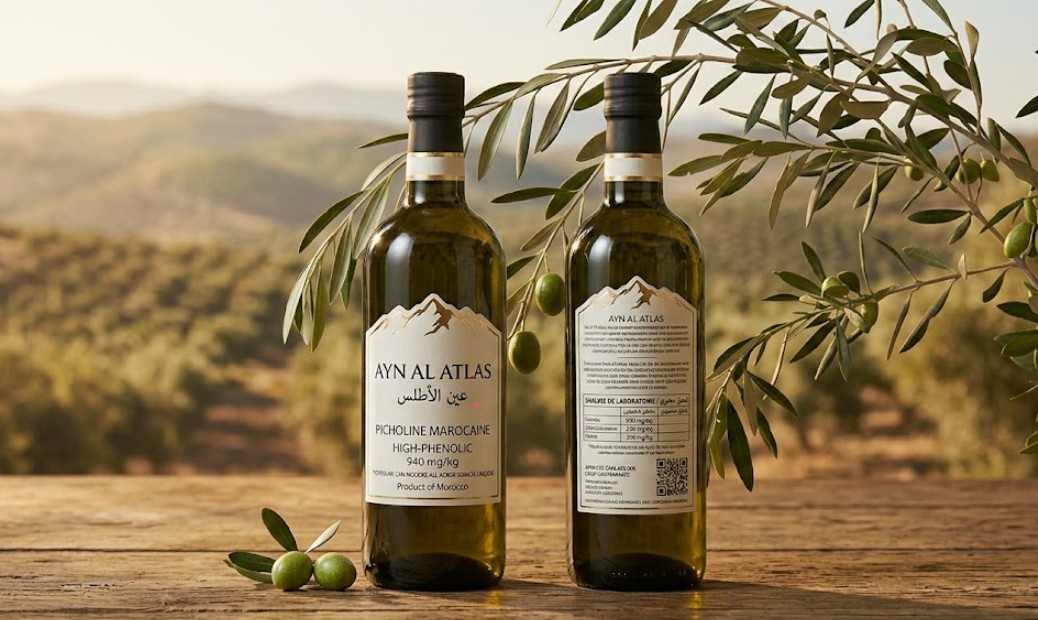
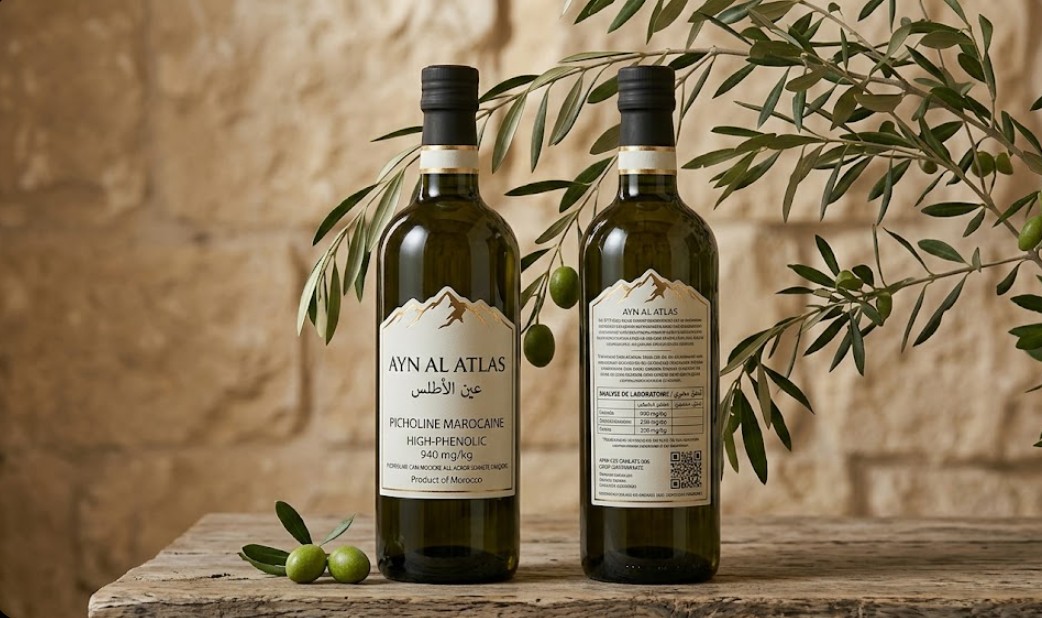
AYN AL ATLAS bottle product shot
100% Picholine Marocaine
Cold pressed · Nitrogen sealed
UV-blocking dark glass
500ml · Batch numbered
Product of Morocco

Matte black. Clean label. Zero compromise.

AYN AL ATLAS
Batch #001

Single varietal Cold pressed Nitrogen sealed UV protected Blockchain verified Product of Morocco

UV-blocking glass preserves every polyphenol from grove to table. Nitrogen-sealed within 4 hours of pressing. The label tells you everything — the variety, the batch, the harvest, the standard.

$45 42 180 د.م

Single batch · 500ml  ·  or $40/month — Subscribe

Atlas Mountains

Daily Protocol

The AAA Ritual

I

06:00 · Morning

The Activation

One tablespoon on an empty stomach. Consumed before food, olive oil polyphenols enter the bloodstream without competing compounds. A practice documented across Mediterranean and North African cultures for thousands of years — now studied in clinical settings.

1 tbsp · Empty stomach
II

12:00 · Cooking

The Finish

High heat degrades phenolic compounds. Finishing — not cooking — preserves them. Pour over grilled fish, roasted vegetables, warm bread after the pan leaves the heat. The Picholine Marocaine's peppery character transforms a dish at the final pour.

2 tbsp · Finish only · No direct heat
III

20:00 · Evening

The Restoration

Two drops on clean skin at night. Squalene — naturally present in Picholine Marocaine oil — shares structural similarities with human skin lipids. Applied in the evening, it works quietly while you sleep. The same stability that keeps the oil fresh protects your skin.

2 drops · Night ritual
The Sensory Legacy

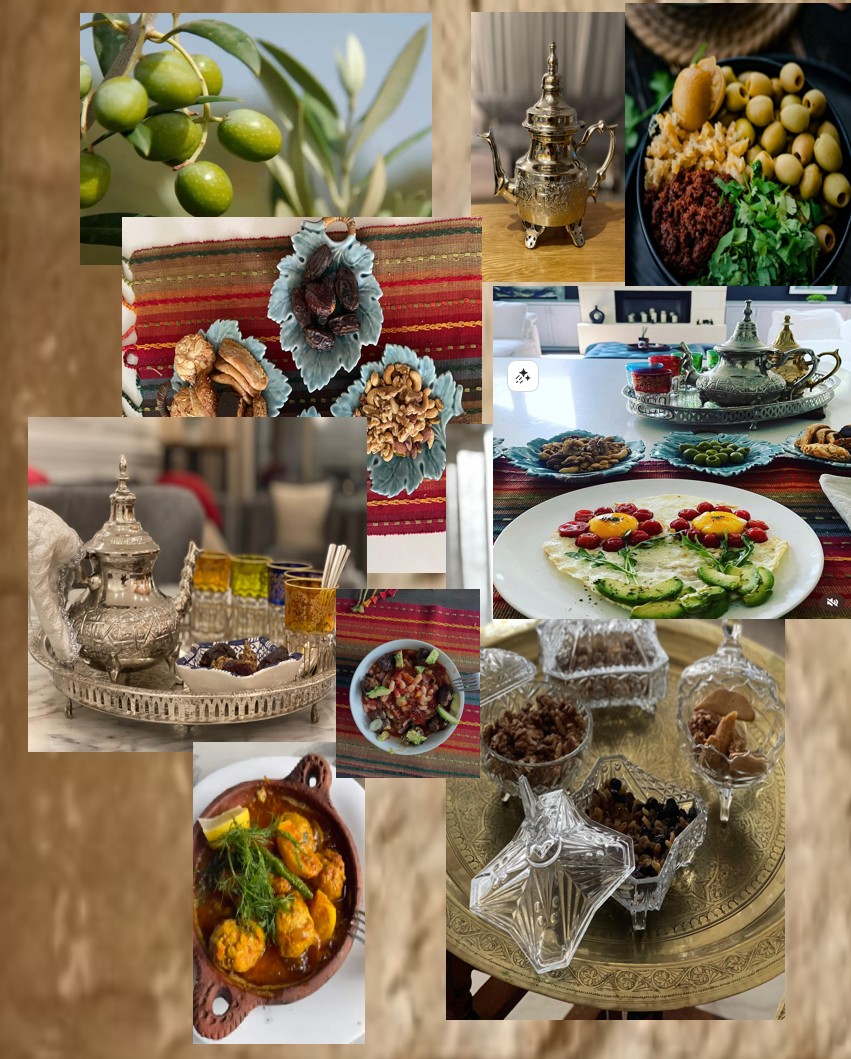
I am from Casablanca. But every harvest season, my mother would pack us into the car and drive south to the family groves. For a child, harvest time felt like Christmas — the air changed, the kitchen never went quiet, and the whole house smelled of fresh-pressed oil. My mother made holiday cookies every season and locked them in a cabinet. At five years old I discovered that if you removed the drawer above, you could reach down into the darkness and find the pyramid of cookies she had stacked on a plate below. I always ate from the top. I always left the base intact. One day the pyramid became a crater. She never said a word. She simply moved the cabinet. AYN AL ATLAS begins in that kitchen.

The batch numbers, the lab reports, the blockchain records — these exist because I spent a lifetime trying to describe with precision what I first experienced as a child reaching into darkness for something worth the risk. The oil has not changed. We have simply found a language for it.
📍
Casablanca & Beni Mellal, Morocco
Middle Atlas · Where AYN AL ATLAS was born

Educational disclaimer: Research cited on this website relates to extra virgin olive oil and polyphenols in general, as documented in peer-reviewed literature and assessed by the European Food Safety Authority (EFSA), the PREDIMED study group, and the EUROLIVE trial consortium. These references are provided for educational purposes only and do not constitute claims about AYN AL ATLAS products specifically. This product has not been evaluated by the U.S. Food and Drug Administration. This product is not intended to diagnose, treat, cure, or prevent any disease. Consult your healthcare provider before making significant dietary changes.